
Fiber Laser Marking Machine for Metal, Plastic & Industrial Traceability
Permanent, high-contrast marks on stainless steel, aluminum, titanium, copper, and engineering plastics — powered by MOPA and Q-switched fiber laser sources with 100,000-hour rated service life and zero consumables.
Available in MOPA configuration for anodized aluminum black marking, stainless steel color marking, and precision plastics — and Q-switched configuration for cost-effective deep engraving on metals. Both support inline production line integration, DataMatrix traceability, and compliance with AIAG, FDA UDI, and AS9100 standards.
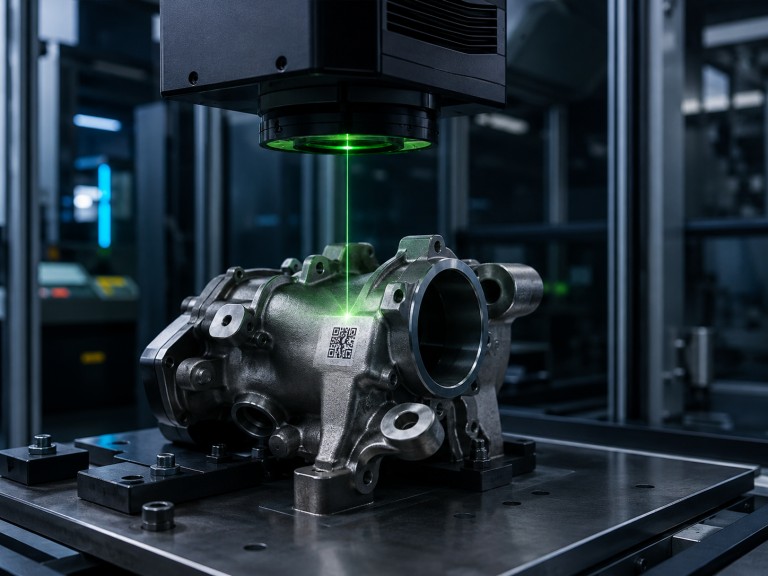
Why Fiber Laser Is the Standard for Industrial Metal Marking
Fiber lasers operate at a 1064nm near-infrared wavelength — precisely where metals absorb laser energy most efficiently. The beam is generated inside a rare-earth doped optical fiber, then delivered through a galvanometer scanning system with no mechanical wear, no gas tubes, and no flash lamps to replace.
The result is a solid-state marking system with a laser source rated for 100,000 operating hours — over 11 years at two-shift production. Air-cooled design eliminates the water chiller required by older YAG and CO2 systems, reducing installation complexity and maintenance overhead to near zero.
Kales offers two fiber laser configurations matched to application requirements: MOPA technology for advanced marking effects and precision plastics, and Q-switched technology for cost-effective deep engraving on standard metal applications.
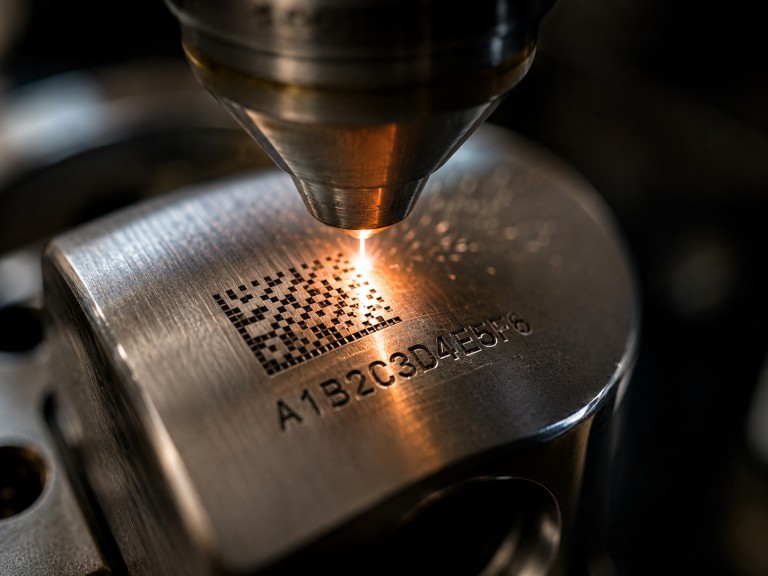
Laser Source Lifespan
Solid-state fiber source with no gas fills, no flash lamps, no alignment required. At 16 hours per day, exceeds 17 years of operation before source replacement.
Repeatability
High-speed galvo scanner maintains sub-micron positioning consistency across the full marking field — essential for DataMatrix and micro-serial number readability.
Zero Consumables
No ink, no solvent, no ribbon, no gas. Air-cooled operation eliminates the water chiller required by older YAG systems. Minimal scheduled maintenance — lens cleaning only.
Galvo Speed
High-speed galvanometer scanner completes a full DataMatrix code on a metal part in under 0.5 seconds — enabling high-throughput traceability without line speed compromise.
MOPA vs Q-Switched — Choose the Right Fiber Laser
Both MOPA and Q-switched systems use a 1064nm fiber laser source and produce permanent marks on metals and plastics. The critical difference is pulse control: MOPA allows independent adjustment of pulse width and frequency, unlocking marking effects that Q-switched systems cannot achieve.
| Capability | MOPA Fiber Laser Advanced | Q-Switched Fiber Laser Standard |
|---|---|---|
| Pulse Width | Adjustable 2–500 ns (independent control) | Fixed ~80–120 ns |
| Frequency Range | 1 kHz – 4 MHz | 20 – 80 kHz |
| Stainless Steel Color Marking | ✓ Full color spectrum via parameter control | ✗ Not achievable |
| Anodized Aluminum Black Marking | ✓ High-contrast, no surface damage | ✗ Gray / frosted result only |
| Precision Plastic Marking | ✓ Minimal thermal damage, clean contrast | △ Risk of yellowing / foaming on sensitive plastics |
| Deep Engraving on Steel | ✓ Fast with pulse width tuning | ✓ Excellent — high peak power output |
| Standard Metal Marking | ✓ All metals | ✓ All metals |
| Laser Source Options | JPT MOPA / IPG | Raycus / MAX / IPG |
| Typical Power Range | 20W – 100W | 20W – 100W |
| Relative Equipment Cost | Higher | Lower |
| Best For | Automotive trim, electronics, medical devices, anodized products | General metal part marking, tooling, deep engraving, cost-sensitive lines |
Not sure which configuration fits your application? Submit your material and marking requirement — our engineering team will recommend the correct laser type and provide a free sample mark within 48 hours.
What Buyers Get Wrong About Fiber Laser Marking
Incorrect technology assumptions lead to wrong equipment selection, failed compliance marks, and avoidable rework costs. These are the four misconceptions we encounter most frequently from industrial procurement teams.
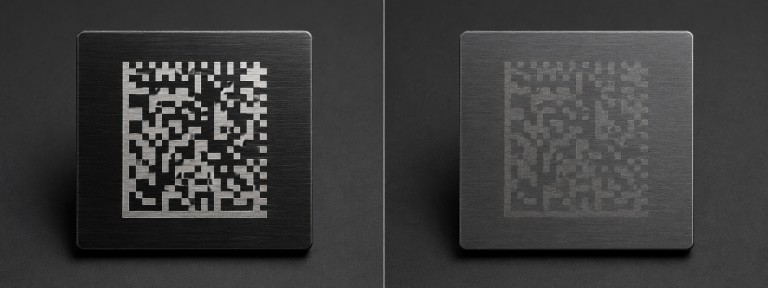
"Any Fiber Laser Can Black-Mark Anodized Aluminum"
Standard Q-switched fiber lasers cannot produce a true deep black on anodized aluminum — the result is typically gray or frosted. Black marking on anodized aluminum requires MOPA technology with narrow pulse width and high frequency parameters that selectively interact with the anodic layer without penetrating or damaging it.
"Higher Wattage Always Means Better Marks"
Wattage determines marking speed, not mark quality or depth per se. A 20W MOPA system produces higher-quality marks on anodized aluminum and engineering plastics than a 50W Q-switched system — because the pulse control architecture matters more than raw power for these applications. Over-powered lasers on thin or sensitive materials cause burning, deformation, and contrast loss.
"Fiber Lasers Mark All Materials — Including Wood and Glass"
Fiber lasers at 1064nm are highly effective on metals, ceramics, and many plastics. However, the 1064nm wavelength is largely transmitted through organic materials like wood, glass, and leather rather than absorbed — producing little to no visible mark. CO2 lasers at 10.6µm are the correct technology for organic and non-metallic materials.
"All Fiber Laser Sources Are Equivalent — Brand Doesn't Matter"
Laser source brand directly impacts beam quality, pulse stability, operating lifespan, and warranty coverage. IPG delivers the highest quality and stability at premium cost. JPT MOPA sources offer superior pulse control for advanced applications. Raycus provides solid performance for standard applications at lower cost. Choosing a machine without knowing the source brand is one of the most common procurement errors in this equipment category.
Two Fiber Laser Marking Configurations for Every Production Environment
Whether your requirement is high-speed inline traceability on a production line or flexible batch marking for mixed-part environments, Kales configures and validates every system against your specific application before shipment.
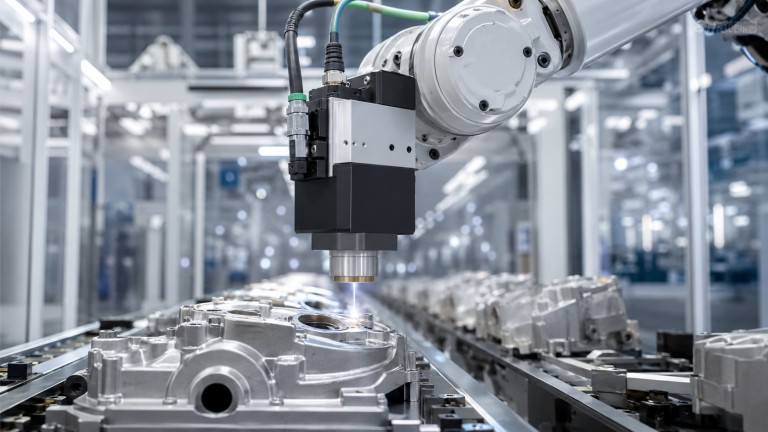
Configuration A — Inline / OEM Integration
Fiber laser marking head integrated directly into automated production lines, robotic cells, or conveyor systems. Marks metal parts on-the-fly with encoder synchronization and PLC-driven variable data in real time.
- TCP/IP, RS-232, and IO trigger interfaces for PLC and MES connectivity
- Encoder-synchronized on-the-fly marking for conveyor-based production
- Variable data marking: serial numbers, DataMatrix, QR, date codes from CSV/ERP
- Compact OEM laser head for robotic arm or gantry mounting
- Ideal for automotive components, medical device serialization, aerospace DPM
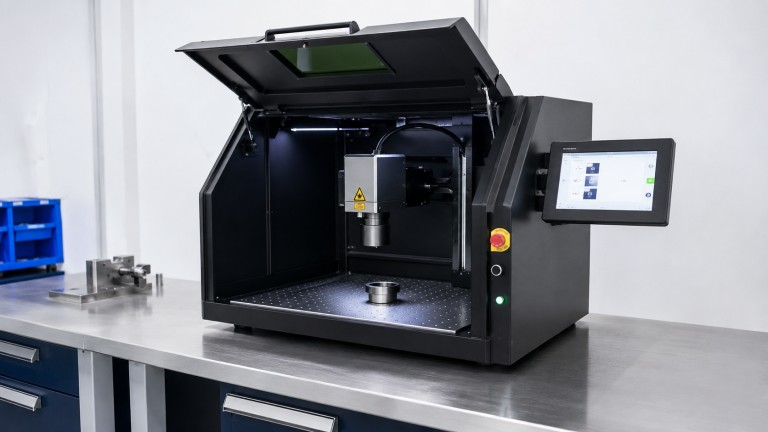
Configuration B — Enclosed Workstation
Self-contained Class 1 laser marking station for batch production, prototyping, and multi-part environments. Full operator control with touchscreen interface, job library, and optional rotary axis for cylindrical parts.
- Class 1 laser safety enclosure — no PPE required for operators
- Rotary axis available for rings, tubes, shafts, and cylindrical components
- Job recall in under 60 seconds — ideal for mixed-part and multi-SKU lines
- Available in MOPA or Q-switched configuration
- Ideal for tooling, medical instruments, jewelry, electronics housings
Software, Variable Data & Production Line Integration
All Kales fiber laser systems ship with EzCad-compatible software supporting serial number auto-increment, database-driven content from CSV or Excel, DataMatrix / QR / GS1-128 / Aztec code generation, and real-time variable data printing synchronized to upstream equipment triggers. No custom middleware or third-party software license is required for standard integration scenarios.
For complex MES or ERP-driven serialization, our engineering team provides integration documentation, sample Python and C# communication libraries, and remote commissioning support. Systems can buffer serialization data and sync automatically on MES reconnection — production is never interrupted by network events.
Fiber Laser Marking Across Three Demanding Industries
Fiber laser marking has become the mandatory traceability technology in industries where compliance codes must survive the full product lifecycle — from manufacturing through field service and end-of-life.
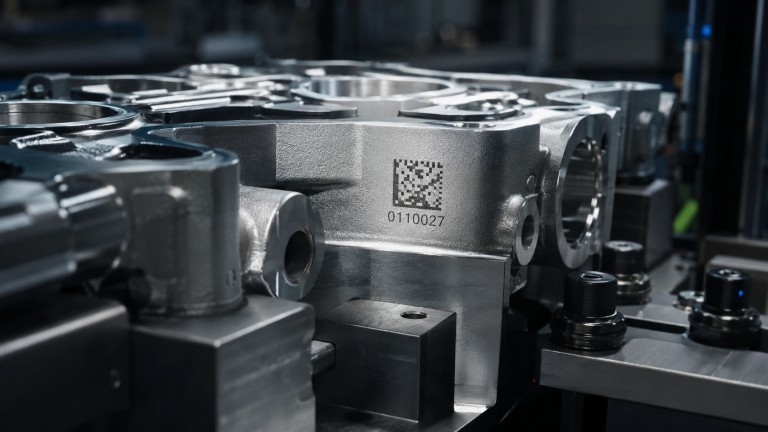
Automotive Manufacturing
Permanent DataMatrix and VIN traceability on engine components, transmission housings, chassis parts, and safety-critical fasteners. Marks must survive heat cycles, lubricants, and mechanical abrasion across the full vehicle lifetime.
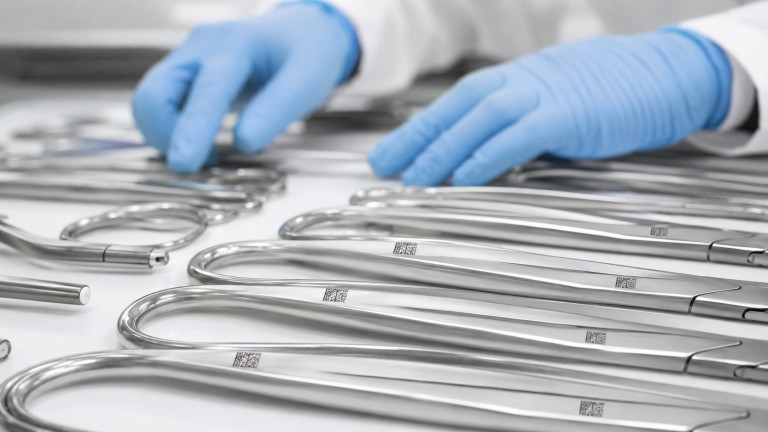
Medical Device & Instruments
UDI-compliant marking on surgical instruments, implants, and stainless steel components. Non-contact laser process preserves sterile surface integrity. Marks survive repeated autoclaving and chemical sterilization without fading or corrosion.
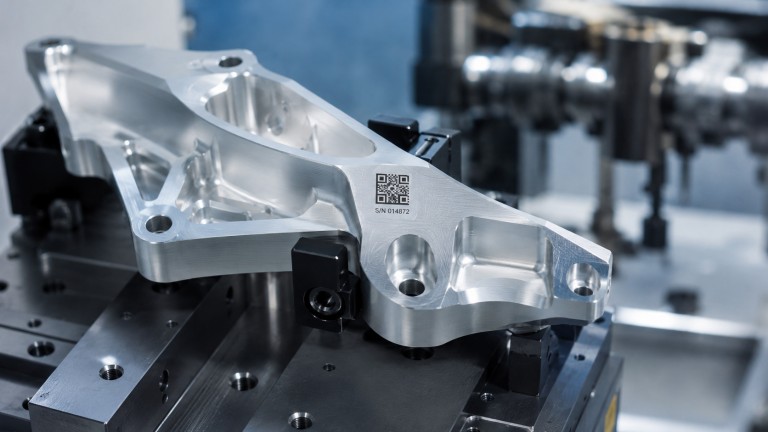
Aerospace & Electronics
Flight-critical part marking with DataMatrix and serial numbers on aluminum alloys, titanium, and high-temperature alloys. Electronics applications include precision marking on connectors, housings, PCB metal components, and anodized enclosures.
Material Compatibility Note
Fiber lasers at 1064nm are optimized for metals (stainless steel, aluminum, titanium, copper, brass, tool steel) and many engineering plastics (ABS, PC, polyamide, PEEK). For non-metallic organic materials — wood, glass, leather, paper, cardboard, PET packaging — a CO2 laser at 10.6µm is the correct technology. Kales provides free material testing to confirm the right laser type before any purchase commitment.
From Inquiry to Production-Ready in Five Steps
Every Kales fiber laser marking system is application-tested, configured, and validated before shipment. We do not ship generic machines — every unit is built and verified against your specific material and compliance requirement.
Application Review & Free Sample Marking
Submit your material sample and marking requirement — serial format, code type, character size, compliance standard. Our engineering team performs free marking tests and delivers results with full parameter documentation within 48 hours.
Laser Type & Configuration Selection
Based on sample results, we specify the correct laser type (MOPA or Q-switched), power level, lens, marking field, and integration options — with written justification. Quotation includes laser source brand and model, no hidden specifications.
Manufacturing & FAT Inspection
System assembled with specified laser source. Full factory acceptance testing (FAT) covering beam quality, marking speed, code grading (ISO 15415), and software variable data function. FAT documentation supplied for automotive and aerospace clients.
Installation & Line Integration
On-site installation, PLC and MES connectivity, trigger signal commissioning, and marking field calibration. Mark quality verified at full production speed before sign-off. IQ/OQ documentation available for FDA-regulated environments.
Training, Warranty & Ongoing Support
Operator training, software walkthrough, and preventive maintenance schedule. Remote diagnostics via TCP/IP. North America and Europe spare parts stock. Laser source warranty coverage confirmed in writing at point of sale.
Standard lead time: 15–25 business days for stock configurations; 30–45 days for custom OEM inline integration builds. Free sample marking turnaround: 48 hours from receipt of material. Contact us with your compliance standard and production timeline — we confirm feasibility within one business day.
Frequently Asked Questions
Both MOPA and Q-switched fiber lasers operate at 1064nm and produce permanent marks on metals and plastics. The critical difference is pulse architecture. Q-switched lasers have a fixed pulse width of approximately 80–120 nanoseconds and a frequency range of 20–80 kHz. MOPA (Master Oscillator Power Amplifier) lasers feature independently adjustable pulse width from 2 to 500 nanoseconds and frequency up to 4 MHz. This flexibility enables MOPA systems to achieve applications that Q-switched lasers cannot: true black marking on anodized aluminum, color marking on stainless steel, and clean high-contrast marks on heat-sensitive engineering plastics. For standard metal marking and deep engraving, a Q-switched system is cost-effective and fully capable. For advanced surface effects or precision plastics, MOPA is required.
IPG Photonics is the global benchmark for fiber laser quality — highest beam quality, best long-term stability, and longest warranty, at the highest cost. JPT is the leading MOPA laser source brand, offering superior pulse control performance for advanced marking applications at a mid-range price point. Raycus is the most widely used Q-switched source in industrial marking, delivering solid performance for standard metal applications at the lowest cost. The right choice depends on your application: for anodized aluminum or stainless steel color marking, specify JPT MOPA. For general metal traceability where upfront cost matters, Raycus Q-switched is highly capable. Kales specifies source brand and generation in every quotation and does not substitute without written approval.
Power primarily determines marking speed, not mark quality or depth in isolation. As a general guide: 20W suits annealing on stainless steel, black marking on anodized aluminum, and light surface marking on plastics at moderate throughput. 30W is the most common all-round industrial configuration. 50W is recommended for high-throughput production lines, deep engraving applications, and harder alloys. 100W is used for very deep engraving, large marking fields, or thick hardened steel parts. If your cycle time requirement is flexible, a lower-power system with higher quality source often produces better marks than a higher-power system with a lower-grade source. Submit your throughput requirement and we will specify the correct power level.
Yes. All Kales inline fiber laser systems include TCP/IP, RS-232, and IO trigger interfaces for PLC and MES connectivity. The marking software supports external trigger signals, serial number auto-increment, database-driven content from CSV or Excel files, and real-time variable data printing. For encoder-synchronized on-the-fly marking on conveyor lines, this is standard configuration. Kales provides integration documentation, sample communication libraries in Python and C#, and remote commissioning support. Systems buffer serialization data locally during network interruptions and sync automatically on reconnection — production continuity is maintained.
Yes, when configured correctly. For FDA UDI compliance, the system generates GS1 DataMatrix codes meeting ANSI/ISO 15415 grading standards, with IQ/OQ documentation available for 21 CFR Part 11 regulated environments. For automotive AIAG B-17 compliance, we configure DataMatrix code quality to meet Grade B or above as required. For aerospace AS9100 and MIL-STD-130 applications, we provide FAT documentation with code quality grading reports. Compliance configuration is application-specific — share your standard requirement at the inquiry stage and we confirm compliance capability before any purchase commitment.
Fiber lasers at 1064nm are highly effective on all metals and many engineering plastics, but are not suitable for organic non-metallic materials. Wood, glass, leather, paper, cardboard, ceramics, and most packaging materials transmit rather than absorb the 1064nm wavelength — producing little to no visible mark. These materials require a CO2 laser at 10.6µm. Some highly transparent or reflective materials may also require surface preparation or a different laser technology. Kales provides free material testing — submit a sample and we confirm suitability and provide marked samples before any purchase decision.
Get a Free Sample Mark on Your Material — 48-Hour Turnaround
Tell us your material, marking content, compliance standard, and throughput requirement. Our engineering team will deliver marked samples with full parameter documentation within 48 hours — at no cost and no obligation.
MOPA or Q-switched. 20W to 100W. Workstation or inline OEM. We configure the system to your specification, not a catalogue default.